
| KEY TAKEAWAYS The check that matters most is interior length. A Britannium 3/4 case gives you 114cm inside, our aluminium case gives you 120cm, and a one piece case gives you 149cm. To easily check the size you need, lay your cue and every extension on the floor in two rows and measure the longer row before you order. Two minutes with a tape measure saves a return. Hard cases offer better protection against heavy knocks, crushing and warping. Soft bags protect against dust and scratches. The UK market for a 3/4 hard case runs from about £45 to £120. Britannia cases sit between £34.95 and £89.95, as of September 2026. Buy for the cue you own now, not the cue you might buy next year. |
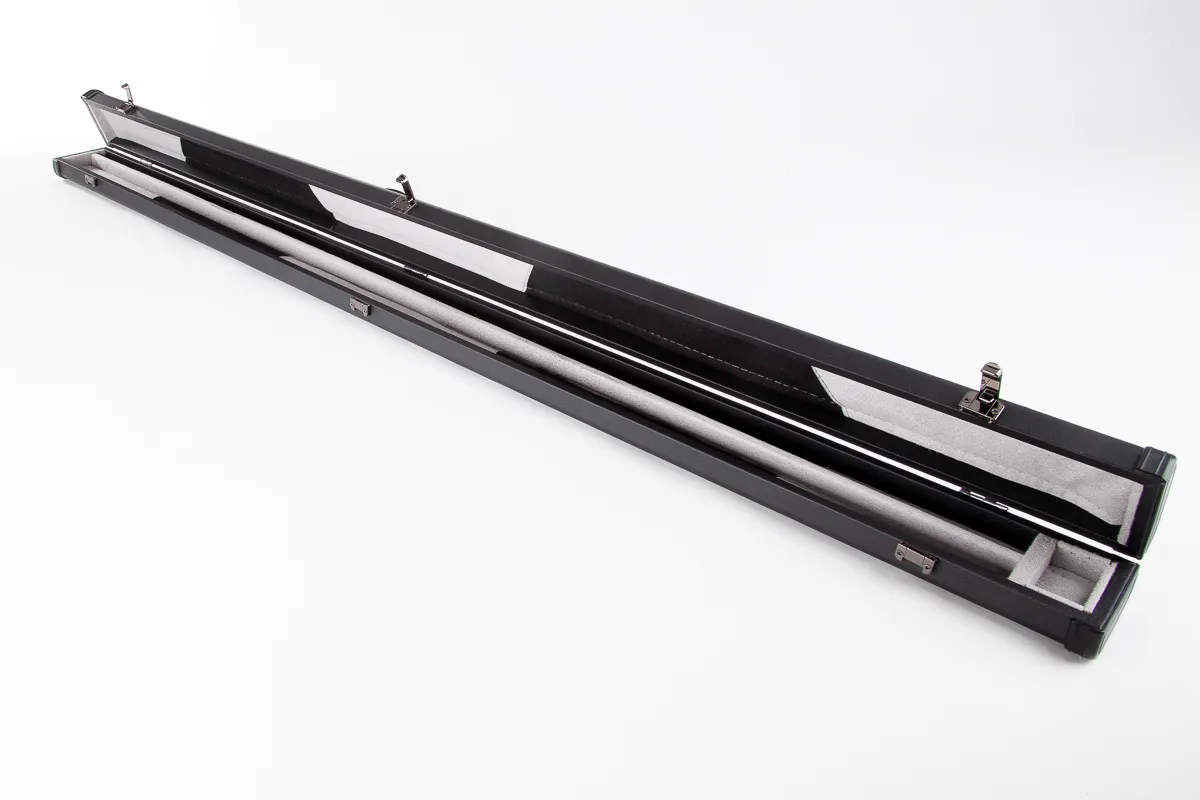
A hand-spliced cue and its mini butt in the padded channels of a Britannium 3/4 case.
A snooker cue case does two jobs. It stops your cue being knocked, dropped or leaned on in transit, and it keeps the shaft protected and dry when the cue isn’t in your hands. Before you buy, check three things: the interior length of the case against the longest section of your cue, whether the case is hard sided or soft, and whether there’s room for your extensions. Everything else is preference.
We’ve been making and supplying cues in Coventry for over 30 years. Most of the damaged cues that come back to us weren’t damaged during a frame. They were damaged in a car boot, on a club floor, or leaning against a wall at home.
Ash is a natural material. It responds to heat and moisture, and it keeps responding for the whole life of the cue. A shaft left in a cold boot overnight and then carried into a warm club is being asked to change its properties twice in an hour. Do that every week for a season, and more often than not, a straight cue stops being straight.
A hard case slows all of that down. It holds the cue flat, keeps it away from direct heat, and stops the shaft picking up moisture from a damp floor or a wet coat. It also helps protect two parts of the cue that are essential to how it plays.
If you’ve spent £120 or more on a handmade ash cue, a case is the cheapest protection you’ll ever buy for it. For the full routine once the cue is home, read our complete guide to cleaning and caring for a snooker or pool cue.
Expert quote from Michael West, Britannia Cues
Most of the cues that come back to us damaged weren’t damaged while anyone was playing. They get knocked about in transit, dinked while not in use, or leaned against something and take a tumble. A protective case that properly fits the cue you own prevents most of that.
The choice comes down to how you travel and what you’re protecting.
| Type | Protection | Weight | Best for | Britannia price from |
|---|---|---|---|---|
| Hard box case, aluminium or Britannium | Impact, crushing, warping | Heaviest | Weekly league players, anyone on public transport and those who want maximum protection | £59.95 |
| Leatherette hard case | Impact and knocks | Medium | Club players who drive to venues and want the protection of a hard case | £39.95 |
| Soft cue bag | Dust, chalk, light scratches | Lightest | Storing a cue at home, short walks to a local club | £8.95 |
A Britannia Cue Bag at £8.95 is the absolute minimum level of protection we’d recommend for your cue. Note that it is only suitable for two piece, centre jointed cues.
If you’re carrying your cue on a bus or a train, we’d recommend stepping up to at least a hard case. In a public setting like this, your cue is out of your full control. It could end up pressed against other people or their bags.

This is where most cue case returns come from, and it’s entirely avoidable.
A full size snooker cue averages 57 inches, roughly 145cm. Nobody carries it at that length unless it’s a one piece cue with no joint. What matters is the longest single section you need to fit once the cue is apart, and whether your extension goes in alongside it.
Do this before you order:
The reason for two rows: most cases have two internal channels, not one. Balancing the rows gives you the real number.
| Case | Interior length | Fits |
|---|---|---|
| Britannium Two Piece | Sized for centre jointed cues | A centre jointed 2 piece cue, no extensions |
| Britannium 3/4 | 114cm, exterior 115cm | A 3/4 jointed cue, mini butt and space for additional extensions |
| Aluminium 3/4, metallic | 120cm, exterior 121cm | Almost all 3/4 length cues and extension combinations |
| Britannium One Piece, 2 slot | 149cm, exterior 150cm | A one piece cue and extensions, or two full size one piece cues with no extensions |
Most retailers don’t publish interior lengths at all, which is why so many cases get returned. If you’re buying a case, do the floor test and check our product listings on the website, or call us with the number before ordering.
For reference, the Britannia telescopic extension measures 69cm, about 27 inches, at its shortest, and extends to 94cm. That is the part players most often forget to measure.
If your longest row comes out between 114cm and 120cm, the aluminium case is the one to look at. Playing with a one piece cue? You need the 149cm case, and nothing smaller will do.
Not sure which joint type you have? Our guide to choosing a snooker cue in the UK covers one piece, centre jointed and 3/4 jointed cues, and our one piece vs two piece pool cues comparison covers the same ground for pool players.
Here is the honest picture of the UK market for a 3/4 hard cue case, checked across the main specialist retailers in August 2026.
| Price band | What you get | Examples on the UK market |
|---|---|---|
| Under £50 | Thin aluminium, basic foam, light latches. Fine for occasional use | Entry aluminium cases from around £49.95 |
| £65 to £90 | The main band. Proper padded lining, moulded ends, secure latches | Most Peradon and Baize Master 3/4 cases sit here |
| £90 to £120 | Heavier construction, better clasps, premium finishes, some hold two cues | Peradon Halo and Baize Master Summit and Fusion cases |
| £200 and up | Real leather rather than leatherette | Genuine leather cases from the specialist retailers |
Britannia 3/4 cases sit below that band: leatherette at £39.95, aluminium at £59.95 and Britannium at £69.95. Only the Britannium reaches into it.
Our honest advice: it isn’t the price that matters, it’s the construction. What to avoid is thin aluminium with basic foam and light latches, which is a lot of what sells under £50. Look for a hard shell with a lined interior and moulded ends and you’re covered. Britannia’s leatherette 3/4 undercuts the main band at £39.95 without being that kind of case: it’s a hard case with a padded, suede lined interior. The aluminium at £59.95 and the Britannium at £69.95 step up the shell rather than the lining. There’s little reason to go above £90 unless you want real leather or need to carry two or more cues.
As a rule of thumb: if the cue cost more than £100, buy a hard case rather than a bag.
We select the cases we sell for protection first. All prices and dimensions below are correct as of September 2026.

| Range | Construction | Price | Fits |
|---|---|---|---|
| Patterned leatherette | Padded patterned leatherette hard case with suede lining | £34.95 to £54.95 | Two piece, 3/4 and one piece sizes |
| Metallic aluminium | Aluminium with ABS end guards and foam lined interior | £59.95 | 3/4 size only |
| Britannium | Aluminium exoskeleton with leatherette covering and felt foam interior | £59.95 to £89.95 | Two piece, 3/4 and one piece |
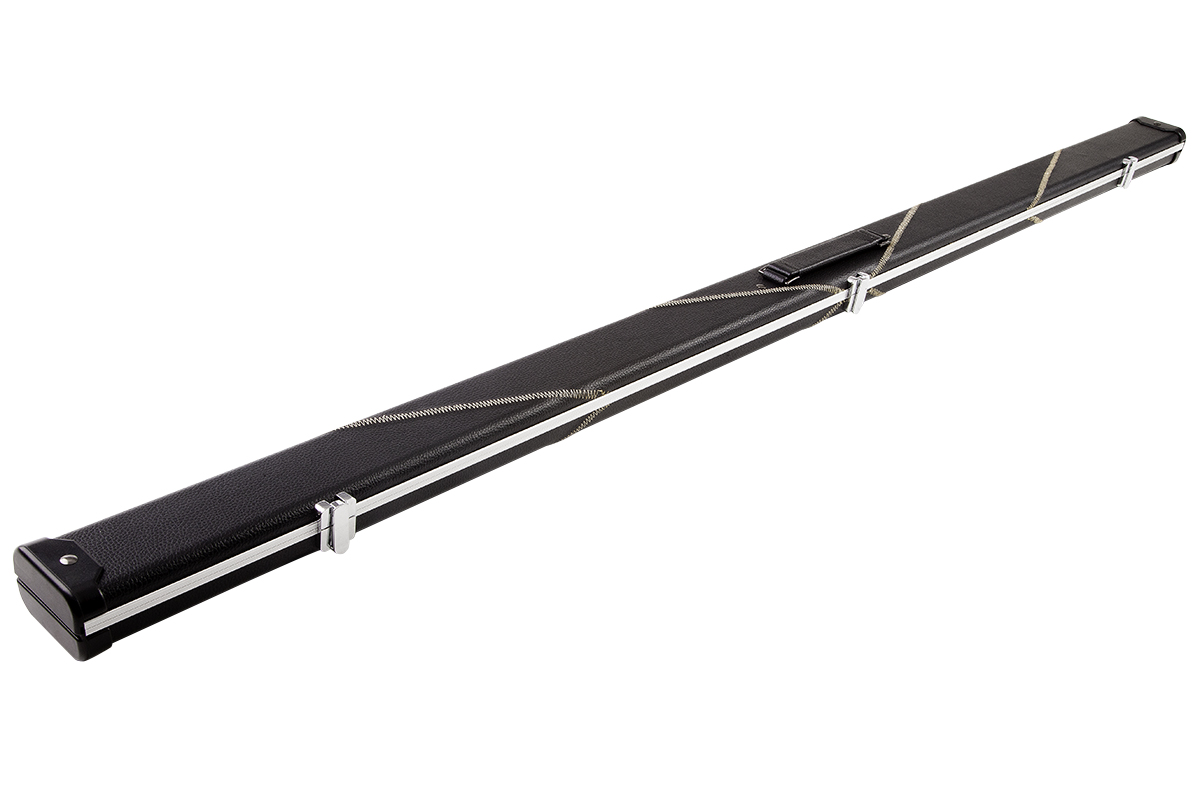
The leatherette range is our widest choice and best value entry point. Two piece cases are £34.95, 3/4 cases are £39.95, and one piece cases start from £54.95.
There are more than twenty designs, including diamond patterns, arrow designs, and Union Jack and England flag finishes. Protection is the same across all of them, so pick based on looks and fit.
One model worth knowing about is the 3 section wide case at £39.95. The extra internal channel suits players carrying a second 3/4 cue, or a full set of extensions and accessories.

The metallic range is our traditional aluminium box case, available in black, silver, gun metal, rose gold, gold, red and blue, at £59.95.
The interior is lined with foam and felt so the contents don’t rattle, and branded ABS moulded end guards on the outside take the impact if the case is dropped on its end. The handle sits low against the body, and the case has sturdy latches.
At 120cm inside, this is one of the most accommodating 3/4 cases we sell. If you carry a cue, a mini butt, a spacer and a telescopic extension, start here.
The Britannium range is our best protection. Each case is built on a heavyweight aluminium extruded frame with a leatherette covering, which makes it slimmer than a traditional box case and harder wearing than a padded one.
Every Britannium case has:
The 3/4 case is £69.95 with 114cm of interior length, enough for a cue, a mini butt and a telescopic extension. The two piece case is £59.95. The one piece case is £89.95, with 149cm inside, enough for a full size one piece cue with extensions, or two one piece cues. Colours include black, brown, red, blue, and a yellow and black finish.
The space around the cue is worth using. These all fit a 3/4 case alongside the cue.
| Item | Price | Why it lives in the case |
|---|---|---|
| Britannia Tip Protector | £3.95 | Stops the tip being crushed against the end of the case while in transit, leaving it ready to go |
| Britannia Cue Towel | £7.50 | Wipe the shaft down before it goes away, and remove any moisture or sweat from your hands |
| Cue Slicker | £2.95 | Takes chalk build up off the shaft in a few light strokes |
| Britannia Magnetic Chalk Holder | £3.95 | Keeps chalk dust and transfer out of your pocket lining |
| Mini Butt Extension | £19.95 | Adds 6 inches of reach for long shots |
| Telescopic Extension | £30.95 | Telescopic reach for long shots, extending from 69cm to 94cm |
One piece of advice from the workshop: keep chalk in a holder rather than loose in the case where possible. Chalk dust gets into the lining, then onto the shaft, then onto your hands, and you end up cleaning the cue twice as often as you need to.
The full routine is in our snooker and pool cue care guide.
Take your measurement, then browse the range. If you’re between two sizes, or not certain your extension will fit, call us on 02476 461234 and we’ll check it with you.
Browse all Britannia cue cases
The best case is the one that fits your cue with room for your extensions and protects it the way you travel. For most UK club players carrying a 3/4 jointed cue, a hard sided case with a padded lining and moulded end protection is the right answer. The Britannium 3/4 case at £69.95 and the aluminium 3/4 case at £59.95 both meet that description, with 114cm and 120cm of interior length respectively.
If you transport your cue regularly, yes. A soft bag protects against dust and light scratches, but it won’t protect a cue from being crushed in a car boot or stood on at a club. If the cue never leaves the house, a soft bag and sensible storage are enough.
Measure the longest section of your dismantled cue, including any extension you carry, and compare it to the interior length of the case. A Britannia 3/4 case gives you 114cm inside, and the aluminium version gives you 120cm. Lay the parts on the floor in two balanced rows and measure the longer row. That number is what has to fit.
Usually, yes. English pool cues are typically the same length as snooker cues or shorter, so a snooker cue case will take one. The joint type matters more than the game: a centre jointed pool cue needs a two piece case, and a 3/4 jointed pool cue needs a 3/4 case. Browse the English pool cue range if you’re matching a case to a new cue.
Yes, and most players do. Keep chalk in a magnetic holder or in a designated section rather than loose, so the dust stays out of the lining. Tip protectors, a cue towel, a slicker and extensions all fit alongside a cue in a 3/4 case. If you carry a lot, look at the 3 section wide leatherette case or the one piece Britannium case.
It helps, but it’s not the whole answer. A case holds the cue flat and shields it from sudden temperature and humidity changes, which is what causes most warping. Where you keep the case matters just as much: away from radiators, away from windows, and never in a car overnight in winter.
The UK market for a 3/4 hard case runs from about £45 to £120, with real leather cases above £200, and most of the specialist range sits between £65 and £90. Britannia’s 3/4 cases run from £39.95 to £69.95, so they undercut that band. Judge on construction rather than price: all three are hard cases with lined interiors, which is not what you usually get under £50.
The Britannium One Piece case takes two full size one piece cues, and the 3 section wide leatherette case has an extra channel for a second cue or a full set of extensions. Standard two channel cases are designed for one cue plus extensions.
