
| KEY TAKEAWAYS What chalk do snooker players use? Cue chalk: a gritty compound, mostly silica, that gives your cue tip grip on the cue ball. Ordinary chalk is a different material altogether. That grip stops the tip sliding off the ball when you strike away from the centre, which is what causes a miscue. Chalk lightly and evenly, cover the whole tip, and never grind the chalk into it. If your tip won’t hold chalk, it has usually glazed over. A tip tool brings it back. Britannia stocks Triangle and Master chalk at £5.95 for 12 cubes, and Taom from £14.00 a piece, as of October 2026. |
What chalk do snooker players use? Snooker players use cue chalk, a gritty compound that is mostly silica, brushed onto the cue tip before a shot to give it grip on the cue ball. Triangle Chalk is billed as an industry favourite, used by top players the world over, and Taom is a premium snooker chalk, handmade in Finland.
Without chalk, the tip can slide off the ball when you strike away from the centre, and you’re far more likely to miscue. It’s one of the cheapest things in your cue case and one of the easiest to get wrong. This guide covers what chalk is made of, how to chalk your cue properly, how often to do it, and how to choose between the chalks we stock.
Cue chalk is mostly silica (quartz). Ordinary chalk is calcium carbonate, a different material altogether. Many modern cue chalks add an abrasive called corundum (aluminium oxide). The minerals are crushed into a fine powder, coloured with a dye and held together with a binder, which is what turns them into a solid cube. Chalk in its modern form dates back to 1897.
The recipe matters. Student research at the University of Sheffield found that a mix of quartz and corundum is much less brittle than quartz alone, and that how thoroughly the two are mixed changes how well the chalk breaks up, which matters for how it works on your tip. Formulas vary from brand to brand, which is why two chalks can feel quite different on the same cue.
The dye was originally green or blue-green, like a traditional cloth. Green and blue are still the colours you’ll see most, and both cube chalks we stock come in either.
The leather tip and the polished cue ball are both smooth. Chalk adds friction between them, which gives the tip something to grip the ball with.
It matters most when you strike the cue ball away from its centre, to play screw, side or top. That’s when a bare tip is most likely to slip off the ball, and that slip is a miscue.
The tip plays its part too. Softer tips hold chalk better than hard ones, which we cover in our guide to snooker cue tips.
Chalking takes a few seconds, but a careless habit leaves bare patches on the tip or wears it out faster. This is how we’d do it.
Before every shot is the safe answer, and it’s what we’d recommend with standard cube chalk. It takes a couple of seconds and it’s the simplest way to cut out miscues.
Players who use Taom tend to chalk less often. Far less of it transfers to the ball than with cube chalk, so it stays on the tip longer. Even then, we’d chalk before any shot that needs side or screw.
Damp matters too. High humidity can stop chalk working as well as it should, so keep your chalk somewhere dry.
We stock two kinds of chalk for snooker cues: traditional cube chalk and premium Taom.
| Chalk | Price | What you get | Colours | In stock |
|---|---|---|---|---|
| Triangle Chalk 12 pack | £5.95 | 12 cubes | Green, blue | Both colours |
| Master Chalk 12 pack | £5.95 | 12 cubes | Green, blue | Both colours |
| Taom Chalk, single | £14.00 | 1 piece | Soft Green, Pyro Blue, Pyro Pink, V2 Blue, V2 Green, V10 Green | Soft Green, Pyro Blue, Pyro Pink and V2 Blue. V2 Green and V10 Green are due back in stock shortly. |
| Taom Chalk, box of 9 | £120.00 | 9 pieces | The same six colours | All six colours |
Prices and stock checked on britanniacues.com on 19 October 2026.
Cube chalk is the traditional choice, and at £5.95 for 12 it works out at about 50p a cube. Triangle Chalk is billed as an industry favourite, used by top players the world over. Master Chalk, made by Tweeten, is billed as the most popular pool chalk in the USA, and it suits snooker too. Both come in green or blue.

Taom is a premium chalk, handmade in Finland, and it comes as a round piece rather than a cube. Players pay more for it because of what Taom says it does: fewer miscues and kicks, less chalk left on the balls and the cloth, and chalk that lasts almost twice as long as other products. We sell only official Taom, singly at £14.00 or in boxes of nine at £120.00.

If you’re new to snooker or play now and then, a box of cube chalk is a sensible, low-cost place to start. If you play a lot and want less chalk on the table, a single piece of Taom is an easy way to find out whether you notice the difference before you buy a box.
Chalk only helps if it’s on your tip, and it’s easy to leave the cube at the other end of the table. We stock two ways to keep it with you:
Both clip over your belt, trousers or pocket, so your chalk goes round the table with you.

Keep a spare in your cue case, out of the damp. Our guide to snooker cue cases covers what else is worth carrying.
If chalk won’t stay on your tip, the tip is usually the cause. It has glazed over: the leather fibres have compressed and closed up, so there’s nothing for the chalk to grip.
A tip tool fixes most cases. The pick on our Britannia Mini 3 in 1 Tip Tool (£10.95) opens up the leather fibres so the tip holds chalk more effectively, and the tool shapes and scuffs the tip to the right curve as well. It’s compact enough to keep in your pocket or cue case.
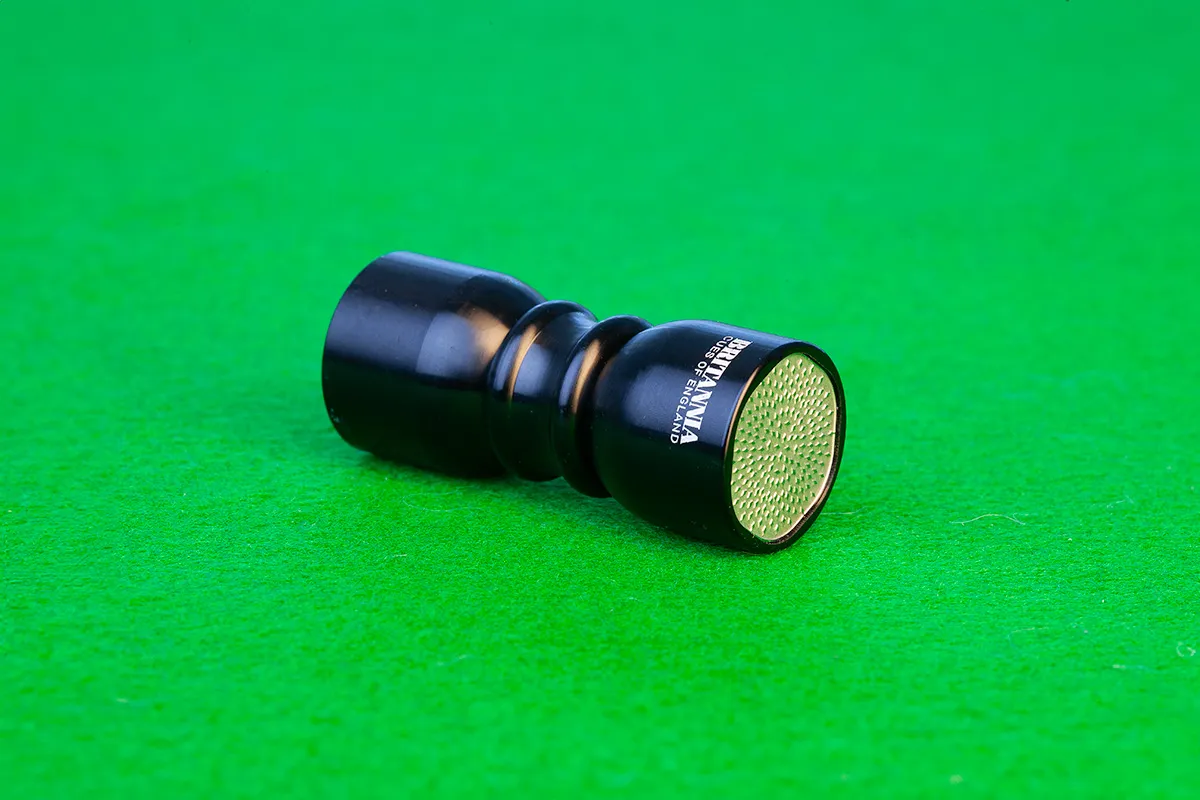
If the tip glazes again within a session or two, it’s time for a new one. The tip replacement section of our complete guide to cleaning and caring for a snooker or pool cue covers fitting a new one.
Tip chalk is for the tip only. It’s abrasive and stains your hands, so don’t use it on your bridge hand.
Some players use hand chalk or talc to help the cue slide smoothly through the bridge, but both are messy, and the dust that builds up on the cloth affects how the balls run. That’s why many players wear a glove instead. Our Billiard Glove (£15.00) has a smooth, low-friction surface and a breathable mesh, in S/M or L/XL, for a left or right bridge hand.

Chalk costs very little, and applying it properly costs nothing. If you’re starting out, a box of cube chalk and a tip tool will cover you. If you play a lot, try a single piece of Taom and see how you get on.
Call us on 02476 461234 if you’d like a hand choosing.
Browse Britannia chalk and accessories
Snooker chalk is mostly silica (quartz), and many modern chalks add corundum, an abrasive also called aluminium oxide. The minerals are crushed into a powder, dyed and held together with a binder. Ordinary chalk is calcium carbonate, a different material altogether.
Chalk adds grip between the leather tip and the cue ball. Without it, the tip can slide off the ball when you strike away from the centre to play screw, side or top, and that slip is a miscue.
Before every shot is the safe habit with standard cube chalk. Players who use Taom tend to chalk less often, because far less of it transfers to the ball and it stays on the tip longer, but we’d still chalk before any shot that needs side or screw.
Bring the chalk to the tip and brush it across with light strokes, turning the cue as you go. Cover the whole tip out to the edges, don’t grind the chalk in, and check for an even, thin coating before you play.
The traditional colour is green or blue-green, like a traditional cloth, and green and blue are still the most common. The choice is yours. Both cube chalks we stock, Triangle and Master, come in green or blue, and Taom comes in a wider range of shades.
Yes: premium chalk, such as Taom. Taom is handmade in Finland and comes as a round piece rather than a cube. Taom says it gives fewer miscues and kicks, leaves less chalk on the balls and the cloth, and lasts almost twice as long as other products.
No. Tip chalk is abrasive and stains your hands. If you want the cue to slide more smoothly through your bridge, hand chalk, talc or a low-friction glove does that job, and a glove keeps powder off the cloth.
Keep it dry, because high humidity can stop chalk working as well as it should. Keep a spare cube in your cue case, and carry the one you’re using in a chalk holder or pouch so it stays clean and to hand.
